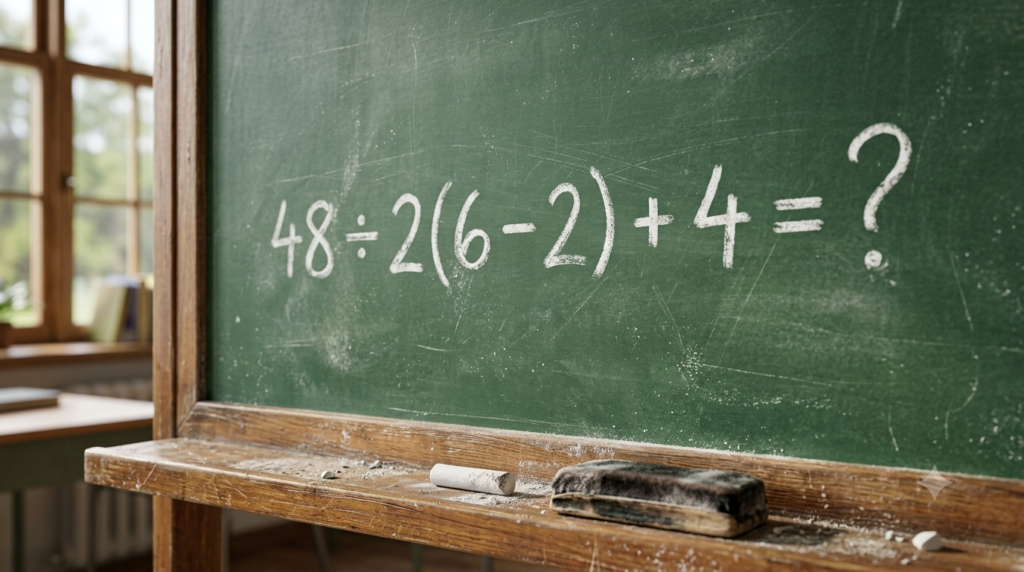
This equation has been going viral for years, and it still splits comment sections every single time it resurfaces. It looks simple. It isn’t.
48 ÷ 2(6 − 2) + 4 = ?
Take a guess before reading on. Most people land on one of two answers — and only one of them is actually correct by the standard rules of math.
Step 1: Parentheses First
Start with what’s inside the parentheses.
6 − 2 = 4
Now the expression looks like this:
48 ÷ 2 × 4 + 4
Step 2: Division and Multiplication, Left to Right
Here’s where most people trip up. Multiplication and division hold equal priority in the order of operations. Neither one jumps ahead of the other — you simply work through them left to right, in the order they appear.
48 ÷ 2 = 24
Now:
24 × 4 + 4
Step 3: Finish the Multiplication
24 × 4 = 96
Then:
96 + 4 = 100
The Answer
Following standard arithmetic rules, the answer is 100.
Why So Many People Get It Wrong
The confusion starts with 2(6 − 2). Plenty of people see that and instinctively treat it as one locked-together unit, multiplying first: 2 × 4 = 8, then 48 ÷ 8 = 6, then + 4 = 10.
That instinct feels natural, but it breaks the actual rule. Multiplication and division share the same priority level — no operation gets to cut in line just because it’s written with parentheses instead of a multiplication sign. 2(6 − 2) is simply shorthand for 2 × (6 − 2), not some special case with invisible extra parentheses around the whole thing.
Bottom Line
By standard order of operations, the answer is 100. If you treat 2(6 − 2) as one inseparable unit, you’ll land on 10 — but that’s not arithmetic anymore, that’s a different interpretation of the notation.
The real lesson here isn’t about who’s “wrong.” It’s that ambiguous notation causes this exact argument every time. Add an extra set of parentheses, and there’s nothing left to debate.
Leave a Reply